A commentary from the home office by Martin Usdrowski, team development coach
The world is in a state of emergency. Many companies are fearing for their economic existence. Quarantine, short-time working, crisis and loans. Many are wondering when all this will be over and when things will finally move on. And whether it will continue at all. And if it does continue, how it will continue. In this entrepreneurial uncertainty, there often seems to be only one saving alternative. Home office is the name of the weapon that is supposed to provide relief for many until the - presumably Nobel Prize-worthy - discovery of the medical vaccine. This is how it sounds from all corners and ends: Home office. But anyone who wants to see this as a miracle cure for the economy should face up to the sober, well-known fact: There are no miracles. However, a look at the facts can give some people some inspiration for the time after the crisis. After all, prevention is better than cure and if there are two certainties left in the world, it's this: Bats will be around for a long time to come. And so will viruses.
Home office, home office, the
But what are we actually talking about? Home office, remote work, teleworking... The devil within four walls has many faces. But do they all mean the same thing? And is there really something for everyone?
First of all, the literal trendsetter in the corona and business category: home office. Although the word comes from English, most Anglo-American entrepreneurs are completely unfamiliar with it. There, the term telecommuting or telework is used instead. If scientists call it telecommuting more accurately, the colloquial term is home office. The core message remains that you bring the office home. As Hannes Wader sang: "Here today, there tomorrow." Switching between the office and home is known as alternating teleworking. And if the ceiling falls on your head both in the office and at home, you should sue the architect. Or take a sabbatical. Or simply try remote working as soon as the coronavirus pandemic is over. The variant known in science as mobile teleworking is characterized by the fact that it can be done anywhere - in the car, at the airport or at your favorite Italian restaurant. Open your laptop and off you go. Zoom and spaghetti will be waiting.
Netflix and co. - working from home needs rules
However, if working from home initially sounds like the fulfillment of absolute freedom, it requires rules, limits and the right coordination with the management department to ensure that the enthusiasm lasts longer than a week.
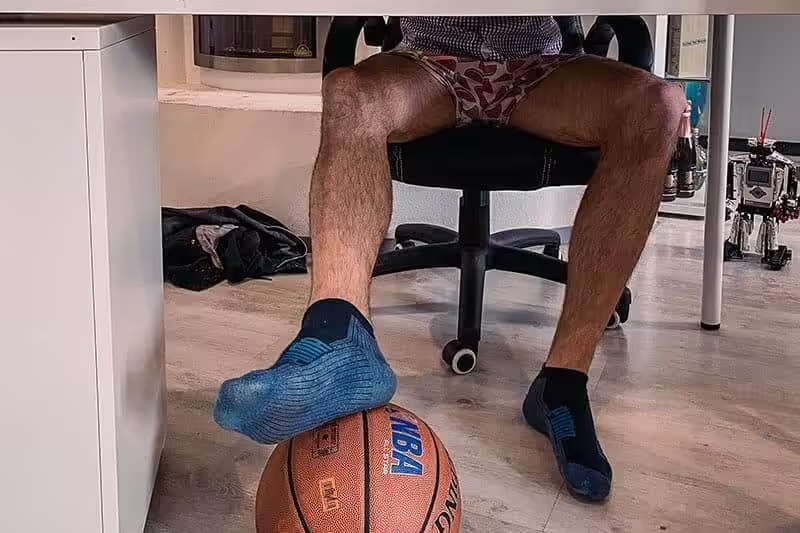
In order to maintain the necessary discipline between children, partner and Netflix, it makes sense to start by turning your home office into a home office. Having your laptop open next to the cereal bowl is not enough. From a purely psychological point of view, when a workplace looks like a workplace, discipline increases. A separate roomor at least a separate area helps. Sufficient lightingthe right office chair and fixed breaks also help. In addition, don't allow yourself to be distracted by family and friends. When working at home, it is generally important to beat your inner bastard. Feel free to dress like you do in the office - This also boosts motivation.
Proper communication with the company is the be-all and end-all. Sure, endless (video) calls pile up as appointments in Outlook. But you shouldn't forget to talk to your colleagues outside of work. So plan a coffee break together in meetings via Zoom, Skype and Microsoft Teams. Try it out - highly recommended!
No added value is created in the home office - or is it?
But hand on heart: is working from home also worthwhile from an economic perspective? Yes and no. It is scientifically proven that bosses' worries about lazy days at home are unfounded. A 13% increase in productivity speaks for itself. The reasons for this are quite simple: just as bats are now also found in wildlife markets, owls and larks are not only found in the forest. The human biorhythm varies from person to person and an adapted working time takes this into account. This may be easier to achieve when working from home, but be careful: sleeping in until midday is still not an option, as the necessary availability for colleagues, customers and superiors also applies here. Nevertheless, the more flexible arrangement can be beneficial for family and personal circumstances - such as childcare. This pays off: People who work from home are more likely to remain loyal to their employer in the long term and are more motivated.
No matter how well-lit the office may be within your own four walls, there are shadows here too. After all, increased productivity is also due to fewer breaks and longer working hours. Increased stress, sleeplessness and, last but not least, possible accidents while cutting leeks that are not covered by insurance are the bitter downer in the home office business solution. Working from home could also become a problem for those who want to keep their professional and private lives strictly separate. Less frequent salary increases and promotions due to lower visibility of the individual's performance round off the whole thing negatively and almost turn the seed of hope of working from home into a shadowy plant.
Conclusion: working from home can work after all
But what do the experts say? Firstly, there are no miracles. Secondly, if you want to retain a little life in your work-life balance, it is not advisable to work from home permanently and completely. It follows from this: It may be complete, but not permanent. Working purely from home should always be considered as a temporary option. For example, in times of personal or social crisis such as these. And: it can be permanent, but not completely. There is nothing to be said against a combined solution in which the employee drops by the office at least 1-2 days a week. In fact, it even offers advantages. And yet German companies still have some catching up to do in this respect. Only four out of ten companies offer employees the opportunity to work from home at all. Time for a change.
And so the last certainties of the day apply: we must see the crisis as an opportunity. Some phrases can sometimes be true. And sometimes it takes Chinese bats to force companies to be flexible in the long term.
The time for working from home is now.